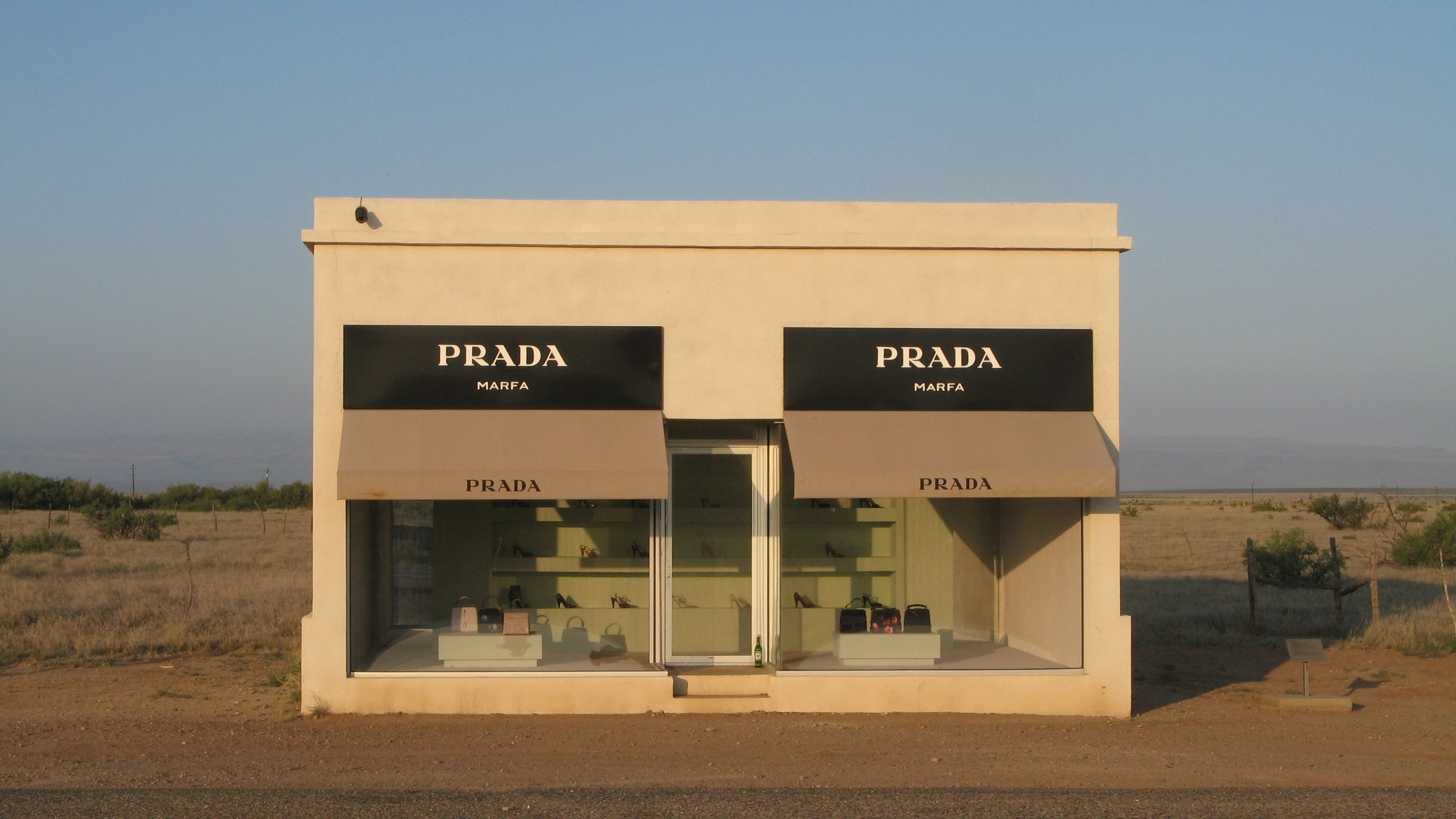
Prada Marfa is a permanent art installation located beside U.S. Highway 90 in Presidio County, Texas, approximately 1.4 miles northwest of Valentine and about 26 miles northwest of Marfa. Designed by the Scandinavian artist duo Elmgreen & Dragset, the structure resembles a small Prada luxury boutique but has never operated as a functioning retail store. It opened on October 1, 2005, and has since become one of the best-known contemporary art installations in West Texas.
The installation was created by Michael Elmgreen and Ingar Dragset, artists known for works that alter familiar architectural spaces or place recognizable objects in unexpected environments. Prada Marfa was intended to resemble a high-end fashion store placed in a location where such a business would make little practical sense. The surrounding landscape consists largely of desert, ranchland, highway and distant mountains, with no major commercial development nearby.
Despite its name, Prada Marfa is not located within the city of Marfa. It stands much closer to Valentine, a small community along Highway 90. The use of "Marfa" in the title connects the work to the larger art culture of the region. Marfa became internationally associated with minimalist and conceptual art largely through the work of artist Donald Judd, who moved there in the 1970s and later established what became the Chinati Foundation.
The project was organized with assistance from Art Production Fund and Ballroom Marfa. Elmgreen & Dragset had previously considered creating a similar installation in Nevada called Prada Nevada, but that project did not move forward. West Texas was eventually selected as the location for the final work.
The building measures approximately 15 feet by 25 feet and was constructed to resemble a small Prada boutique. Its exterior includes a white stucco facade, large glass display windows and black Prada logos. The interior contains shelves, display platforms and lighting arranged in a manner similar to an actual luxury store.
Prada participated indirectly in the project by allowing the artists to use the company's name and visual identity. Miuccia Prada selected merchandise from Prada's Fall/Winter 2005 collection for display inside the installation. The original contents included handbags and shoes, making the interior appear similar to a real Prada shop.
The structure, however, was intentionally designed so customers could never enter it. The door is permanently sealed, and none of the merchandise is available for purchase. The inability to enter or shop is central to the concept of the installation. The artists removed the commercial function from a structure that visually appears entirely devoted to commerce.
Prada Marfa has commonly been interpreted as a work about consumerism, luxury branding, commercial architecture and the relationship between art and fashion. The location creates a deliberate contrast between an internationally recognized luxury brand and the sparsely populated Chihuahuan Desert. A type of storefront normally found in an affluent shopping district instead stands beside a remote highway.
The artists originally intended the structure to receive little maintenance and gradually deteriorate in the desert. Weather, dust and time were expected to become part of the artwork. That plan was disrupted almost immediately.
Only days after Prada Marfa opened, vandals broke into the installation. The original handbags and shoes were stolen, and the building was damaged. According to Ballroom Marfa, a truck and chain were used to pull off the door, and the structure was also shot and covered with graffiti.
The artists and organizers decided to repair the building rather than allow that sudden destruction to determine its appearance. Prada supplied replacement merchandise, but steps were taken to make the items less attractive to thieves. Replacement shoes were displayed only as right shoes, meaning they could not be used as wearable pairs. Handbags were modified by cutting holes into their bottoms.
Security improvements were also added, and the installation began receiving limited maintenance despite the artists' original idea of allowing natural deterioration.
The building was vandalized again in March 2014. During that incident, the structure was painted blue and covered with signs, banners and other materials by an artist who described the alteration as an art project of his own. The original Prada Marfa appearance was later restored.
Another major issue emerged in 2013 when the Texas Department of Transportation questioned whether the Prada logos made the installation an illegal roadside advertisement. Texas regulates advertising signs located near highways, and the structure's large corporate branding created an unusual legal problem.
The debate centered on whether Prada Marfa should be treated as artwork or commercial advertising. The artists were not selling Prada products from the building, and Prada had not created the project as a conventional advertising campaign. Nevertheless, the installation visually resembled a commercial storefront and prominently displayed a corporate trademark.
The issue was eventually resolved through an arrangement that allowed the installation to remain. The site came to be treated as a museum, with the Prada Marfa structure functioning as its principal exhibit. This allowed the branding on the building to be classified differently from a conventional roadside billboard.
Over time, Prada Marfa became significantly more famous than the artists originally anticipated. It has appeared in fashion photography, television programs, travel documentaries, music-related imagery and social media posts. It also became a popular stop for travelers driving between Marfa and El Paso.
Visitors cannot enter the building, but they can approach it from the roadside and look through the windows. The interior remains illuminated at night, causing the structure to resemble an operating luxury boutique even when the surrounding desert is almost completely dark.
The installation's remote location has become one of its defining characteristics. A functioning Prada store depends on access to customers, retail traffic and a commercial environment. Prada Marfa lacks nearly all of those things. It uses the architecture and visual language of a store while removing the economic activity that normally gives such a building its purpose.
The project has also become an example of how the meaning of public art can change over time. It began primarily as a conceptual artwork examining consumer culture and branding. After repeated vandalism, legal disputes and increasing tourism, it also became a roadside landmark and an important part of the cultural identity of Far West Texas.
The building continues to be maintained by Ballroom Marfa and associated organizations. Repairs are carried out when necessary to preserve the structure, although the installation is not intended to function as a conventional commercial building.
Prada Marfa remains one of the most recognizable works created by Elmgreen & Dragset. Its popularity has sometimes overshadowed the conceptual idea behind it, with many visitors treating it primarily as an unusual photo location. However, the basic contradiction created by the artists remains intact.
Tags
Location
Views
11
Be the first to comment!